Wednesday, November 6, 2013

CIRCUMCISION AND RAPE.

Circumcision and Rape: Does a Victim’s Memory Matter?


Several days ago, Intact America posted this meme on Facebook:

The response was astonishing – the posting got the greatest number of views and comments, by far, of anything we’ve ever posted on our Facebook page.

Many of the comments contained arguments and rejoinders about the relative “badness” of circumcision and rape; some objected strenuously to the insinuation that circumcision was “as bad as” rape; and others said that circumcising an unconsenting infant was “worse than” raping an unconscious woman.

These arguments miss the point of the meme, which is: The fact that a victim has no memory of having been wronged does not mean that a wrong has not been done, nor does it let the wrongdoer off the hook.

Think of it this way: If a neighbor enters your home unbeknownst to you, takes a gold necklace from your jewellery box, and leaves, and you never discover that the necklace is missing, did a burglary occur?
Of course. Is the neighbour who took the necklace not guilty, simply because you didn’t miss the item?
Of course not. Your home was burgled, and your neighbour is guilty of burglary.


Why should wrongs committed upon someone else’s body be different from a property crime?

Both circumcision and rape meet the common law definition of batteryan intentional, unpermitted act causing harmful or offensive contact with the “person” of another.


^^^^^^^^^^^^^^^^^^^^^^^^^^^^^^^^^^^^^^^^^^^^^^^^^^
^^^^^^^^^^^^^^^^^^^^^^^^^^^^^^^^^^^^^^^^^^^^^^^^^^^

.

REASONS: CIRCUMCISION RATE HAS DECLINED.

Circumcision Rate Has Declined Over 30 Years.


4 Reasons the Circumcision Rate Has Declined Over 30 Years...


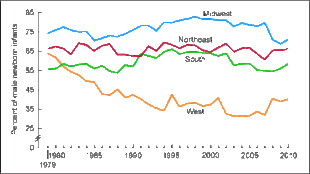
The rate of circumcisions performed on newborn boys in US hospitals has steadily declined over the last three decades, the US Centers for Disease Control (CDC) has said in a new report.

Overall, the national rate dropped about 10 percent, but the numbers varied dramatically by region. 

The CDC's report looked at rates of newborn boys circumcised in hospitals from 1979 to 2010.

It's important to note that since it only includes hospital circumcisions in its figures - and not any performed outside hospitals, such as those done in religious ceremonies - it doesn't give a complete picture of the rate of circumcision in the US. 


In 1979, 64.5 percent of newborn boys were circumcised in hospitals, the report says.

Overall, circumcision rates were the highest in the Midwest, with a high of 82.9 percent in 1989 and a low of 68.8 percent in 2009. While the rate stayed flat in the Northeast, the decline was especially steep in the West.

Over the 32-year period studied, rates in the West dropped 37 percent, from 63.9 percent in 1979 to 40.2 percent in 2010. The lowest rate recorded over the three decades was in the West, where only 31.4 percent of newborn boys were circumcised in hospitals in 2003.

Let's take a look at some of the reasons for the decline......


^^^^^^^^^^^^^^^^^^^^^^^^^^^^^^^^^^^^^^^^^^^^^^^^^^^^^^^^
^^^^^^^^^^^^^^^^^^^^^^^^^^^^^^^^^^^^^^^^^^^^^^^^^^^^^^^

Wednesday, September 18, 2013

CIRCUMCISION CONTROVERSIES.

CIRCUMCISION CONTROVERSIES.


Male circumcision has often been, and remains, the subject of controversy on a number of grounds—including religious, ethical, sexual, and health.

The Ancient Greeks and Romans valued the foreskin and were opposed to circumcision—an opposition inherited by the canon and secular legal systems of the Christian West that lasted at least through to the Middle Ages, according to Hodges. Traditional Judaism and Islam have advocated male circumcision as a religious obligation.

The ethics of circumcision are sometimes controversial. From the mid-19th century, there has been advocacy in some Anglophone countries on medical grounds, such as the prevention of masturbation and "reflex neurosis".

Modern proponents, such as Brian Morris, argue that circumcision reduces the risks of a range of infections and diseases as well as conferring sexual benefits.

In contrast, opponents, particularly of infant circumcision, often question its effectiveness in preventing disease, and object to subjecting newborn boys, without their consent, to a procedure they consider to have debatable benefits, significant risks and a potentially negative impact on general health and later sexual enjoyment.


^^^^^^^^^^^^^^^^^^^^^^^^^^^^^^^^^^^^
^^^^^^^^^^^^^^^^^^^^^^^^^^^^^^^^^^^^
 
.

Tuesday, September 17, 2013

IS NON-THERAPEUTIC CIRCUMCISION MORALLY PERMISSIBLE?

Is the non-therapeutic circumcision
of infant boys morally permissible?


You may have the idea that the foreskin of the penis is nothing but a disease-incubating, hard-to-clean nuisance, my moral points notwithstanding. But you’d be wrong. The foreskin serves more than one important function.

First, it protects the soft, moist, and sexually-sensitive glans penis from environmental degradation. The “head” of a circumcised penis, in contrast, becomes leathery and tough, as well as desensitized, as it rubs against clothing and other foreign elements year after year. Second, it serves a sexual function as well.
The nerve endings on a foreskin’s inner surface become exposed when the penis is engorged—while the foreskin glides over the glans during intercourse—increasing pleasure for both partners and making vaginal dryness less likely a problem.

As one of my readers, citing this study, relates:

The foreskin contains 85% of the sexually receptive nerve endings of the penis. The “ridged band,” also known as the “preputial sphincter” is the most sensitive part of an intact male’s body, containing 20,000 meisner’s corpuscle nerve endings.
These are the nerve endings that sense light touch, as in the anus or lips. They are also found in highly concentrated patterns on the palms of our hands and soles of our feet.
[To get a rough idea of the difference between an intact versus a circumcised penis on the sensitivity dimension] compare the sensation of gently gliding a finger over your palm versus the back of your hand.

In fact, circumcision first became a standard medical practice in the US, and subsequently a mindless cultural habit, specifically as a means to combat masturbation.

The aim, that is, was to reduce the sexual function of the penis:

In cases of masturbation we must, I believe, break the habit by inducing such a condition of the parts as will cause too much local suffering to allow of the practice being continued. For this purpose, if the prepuce [foreskin] is long, we may circumcise the male patient with present and probably with future advantage; the operation, too, should not be performed under chloroform, so that the pain experienced may be associated with the habit we wish to eradicate.
(“On An Injurious Habit Occasionally Met with in Infancy and Early Childhood.” The Lancet, Vol. 1; 7 April 1860.)

We’ve moved past the folly of anti-masturbationism; we should move past the cruelty of circumcision as well.


^^^^^^^^^^^^^^^^^^^^^^^^^^^^^^^^^^^^^^^^^^^^^^^^^^^^^^^^^^^^^^^^^^^^^^^^^^^^ 
^^^^^^^^^^^^^^^^^^^^^^^^^^^^^^^^^^^^^^^^^^^^^^^^^^^^^^^^^^^^^^^^^^^^^^^^^^^^^

.
Friday, September 13, 2013

RIDICULOUS CIRCUMCISION EUPHEMISM.


Ridiculous Circumcision Euphemism.


Dr. Limakatso Lebina’s Ridiculous Circumcision Euphemism.

Anyone familiar with the way voluntary, adult male circumcision is being promoted as a way to reduce the risk of female-to-male HIV transmission in high-risk populations already knows how it’s promoted. The brochure excludes context-specific qualifiers.

That mouthful in the first sentence is always shortened to “circumcision reduces the risk of HIV”, even though that broad statement isn’t supported by the studies.

In addition, voluntary, adult male circumcision loses words over time.
Adult was the first word to go. Voluntary is still used, but that word doesn’t mean what it’s used to represent. Consent must only come from the patient when the circumcision is non-therapeutic.


Absent that consent, the surgery shouldn’t be imposed on a healthy minor.
In a discrediting move, no one adheres to that.
It took six days from the 2006 release of the major HIV study on voluntary, adult circumcision in Africa for the U.N. to propose targeting infants first among all males in HIV-ravaged parts of Africa. Perpetuating circumcision via physical indoctrination is the new standard.

Voluntary disappeared a long time ago as anything more than a marketing word.


I do not wish to suggest I think this is a conspiracy. Public health officials believe they are acting nobly. A well-meaning focus on one’s own preferences explains this at least as well.
We must do something to reduce HIV. Circumcision is something. Therefore, we should circumcise.

That’s bad logic, and relies too heavily on the nonsensical idea that someone happy with being circumcised proves everyone will be happy being circumcised.

It treats the individual as a tool to achieve some public goal. That’s mistaken but it seems rooted in good intentions.


Now, knowing all of this, I’m difficult to surprise with how public health officials promote circumcision. I expect dumb, offensive strategies.

Rather than “voluntary” male circumcision, we have a “love cut”.
This is no different than asking opponents “Why do you want people to get HIV?” as if one can’t be opposed to both non-voluntary forced circumcision and the transmission of HIV.

Here, Dr. Lebina implies that an intact man who won’t have himself circumcised doesn’t love his partner as much as someone who would have himself circumcised.

It’s preposterous. It also encourages parents to circumcise their sons because they love them.

That’s twisted. Circumcision is not a gift.


Public policy needs to return to voluntary, adult male circumcision and mean it.

Euphemisms like this, however well-intentioned, are Orwellian distortions that hide the ethical issues from those promoting and from those deciding on circumcision.


^^^^^^^^^^^^^^^^^^^^^^^^^^^^^^^^^^^^^^^^^^^^^^^^^^^^^^^^
^^^^^^^^^^^^^^^^^^^^^^^^^^^^^^^^^^^^^^^^^^^^^^^^^^^^^^^


..

Thursday, September 5, 2013

Tuesday, August 27, 2013

MAN LOSES PENIS IN MEDICAL CIRCUMCISION.

MAN LOSES PENIS IN MEDICAL CIRCUMCISION.


At 44 years, Patrick Izimba, is a lost man after he lost his penis to a botched male medical circumcision procedure in a private clinic.
Izimba is at Mulago Hospital’s Urology Ward 2A, where he has endured pain for the past three weeks. 
 
Speaking with teary eyes, Izimba curses the day he read a sign post at the private clinic that offers free male medical circumcision
 
“I underwent an operation at Medik Medical Centre Limited in Kawempe,” he says. “Free things are expensive they have cost me a life.
I depend on pain relievers. My penis is falling off and requires me to wear a skirt.”
 
“Pain killers have become my daily bread because if I do not take them, I cannot sleep,” Izimba narrates. Izimba has a catheter connected to his bladder to allow urine to flow out. 

Start of his woes...
On the fateful day, Izimba met Dr. Kunonya who told him the circumcision was free, but he had to pay sh20,000 for the drugs.
Izimba paid the money and was asked to bring Jik and a polythene bag to place on the surgical table. 
 
He recalls that before the surgery, Dr. Kakooza administered an injection which was painful.
I objected to the operation, but Kunonya shouted at me: "Be a man, don’t fear."

Meanwhile, Kunonya sprayed something on my nose that threw me into sudden deep sleep,” Izimba recalls. 
 
He woke up three hours later.
“My penis was very stiff and I had lost a lot of blood.
They bandaged the penis to prevent further bleeding.
Kunonya, Kakooza and two unidentified ladies surrounded me,”  
 
“Kunonya transferred me to another room and I was put on a drip.
I was weak. They gave me tablets to swallow.
I had a sleepless night due to the pain and the penis remained stiff.

The following day I reported for dressing in terrible pain, the penis skin became dry and pale,” he says. 
 
On the third day, Izimba’s penis was still stiff; the skin had tuned so dark and began to peel off. 
However, Kunonya insisted I dress the wound using warm water mixed with salt. 
 

^^^^^^^^^^^^^^^^^^^^^^^^^^^^^^^^^^^^^^^^^^^^^^^^^^^^^^^^^^
^^^^^^^^^^^^^^^^^^^^^^^^^^^^^^^^^^^^^^^^^^^^^^^^^^^^^^^^^^
 
..

Thursday, August 22, 2013

THE PHYSICAL INTEGRITY OF CHILDREN.

COMMITTEE CONDEMNS VIOLATIONS

OF THE

PHYSICAL INTEGRITY OF CHILDREN.


“Some parents, often with the best of intentions, give their consent to medically unjustified operations or interventions, which may have serious consequences for the physical integrity of their children, some of whom suffer for the rest of their lives,” said Marlene Rupprecht (Germany, SOC), whose report was today adopted by the PACE Committee on Social Affairs, Health and Sustainable Development.

The practices condemned by Ms Rupprecht include the circumcision of young boys for religious reasons, female genital mutilation in some cultures, medical interventions in the case of intersexual children, and the submission to or coercion of children into piercings, tattoos or plastic surgery.

If circumcision seems to be indicated for medical reasons, its necessity should be closely examined on a case-by-case basis; in the religious context, families should be systematically made aware of the risks of the procedure and be provided with full information on the alternatives, the report says.

The committee found that female genital mutilation, which evidently has no medical benefit whatsoever but is a procedure intended to control the sexual behaviour of girls and women throughout their lives, must be officially prohibited through legislation, backed by effective measures and sanctions to eradicate the practice and make the public aware of the problem.

The report recommends various steps that can be taken to effectively protect children, in particular filling the most evident legal loopholes (for example, by prescribing that only qualified medical staff be allowed to undertake circumcisions, in sterile conditions), educating families so that they understand the risks involved in certain operations, and, in the longer term, changing deeply rooted and unquestioned religious and cultural practices that can very often be harmful to children.


^^^^^^^^^^^^^^^^^^^^^^^^^^^^^^^^^^^^^^^^^^^^^^^
^^^^^^^^^^^^^^^^^^^^^^^^^^^^^^^^^^^^^^^^^^^^^^^^
 
...

CARE FOR THE UNCIRCUMCISED PENIS.

THE UNCIRCUMCISED PENIS

and

HOW TO CARE FOR IT.


The rates of circumcision are on the downturn, which means more parents will have questions about how to care for an uncircumcised penis in the future.

Parents – and their sons – often have heard confusing, conflicting or just plain wrong information about how to care for the uncircumcised penis.

I have seen teen boys who have come in, concerned about whether or not they will be able to have sex in the future, because they aren't circumcised.

Let's set the record straight on what's normal, what's a problem and what is an emergency.


^^^^^^^^^^^^^^^^^^^^^^^^^^^^^^^^^^^^^^^^^^^^^^^^^^^^^^^^^
^^^^^^^^^^^^^^^^^^^^^^^^^^^^^^^^^^^^^^^^^^^^^^^^^^^^^^^^^
 
...

MALE REPRODUCTIVE SYSTEM.

MALE REPRODUCTIVE SYSTEM.

(Male Urogenital System)


What is the male urogenital system?

The term urogenital refers to something that has both urinary and genital origins.

The word urogenital is used because the urinary and reproductive systems in males merge.

The male urogenital system consists of several parts, including the testes, epididymis, vas deferens, ejaculatory ducts, urethra, penis, prostate and accessory glands. 


^^^^^^^^^^^^^^^^^^^^^^^^^^^^^^^^^^^^^^^^^^^^^^^^^^^
^^^^^^^^^^^^^^^^^^^^^^^^^^^^^^^^^^^^^^^^^^^^^^^^^^^
 
...

Blog Archive